
A B C D E F G H I J K L M N O P Q R S T U V W X Y Z ?
- c
- 1. verb0 The abbreviation for the 'commands' command.
- 2. noun The programming language in which MUD2's interpreter is currently coded. It is always capitalised in this context. C is derived from (and some would say is a bastardisation of) BCPL, in which MUD1's interpreter is written.
- CAB
- noun Abbreviation for 'contrived abbreviation'. Naturally, CAB is itself a CAB. Compare CAT.
- castle in the air
- 1. noun A large-scale design for a new area of The Land which has obviously had many hours spent on it lovingly being refined, but which is nevertheless completely unoriginal drivel. Invariably, such material is submitted laser-printed and neatly bound in a folder by a plodder. See undersea city, tidal, baloons (2).
- 2. noun The stock reply to a MUD-ignorant journalist who asks what the next new addition to The Land will be. See size.
- carrier loss
- noun The sudden and violent interruption of the communications link between a player's computer and the host upon which MUD runs. Such is the way that telephones are constructed, this will almost always happen during combat, thus leading either to the death death of the persona concerned (in which case the affected player will moan about it) or, mythically, to the escape of the persona (in which case the opponent would moan about being cheated out of points for the kill). More often than not, both players concerned will moan. See pslam, BT.
- CAT
- noun Abbreviation for 'contrived acronym term'. A name is a CAT when it consists of tortuously implausible letter assignments in an effort to construct a real (or at least pronounceable) word. The name MUD is an archetypal CAT, as are MUG, MUSE and most other MU* derivations. Unsurprisingly, CAT is itself a perfect CAT. Compare CAB.
- champ
- noun Generic, gender-independent form of the 'champion/championne' level. See dogfood.
- char
- noun The usual contraction of character (1) (2).
- character
- 1. noun A synonym of persona. Aside: In the olde days, MUD used to keep information about personae in separate files, one per player, instead of having a single persona file. The name of the file was CHARAC.TER, and each player could only have one per file system. Later, they were allowed several of the form <name>.MUD, eg. NODDY.MUD, but the readiness with which players could edit these files soon lead to the development of the present persona file system..! Many people, especially newbies, refer to personae as characters (or as chars), although true addicts rarely do so unless their pedigree goes way, way back.
- 2. noun What an ASCII code represents, usually with the implication that it's printable. Since keyboards can produce symbols which are neither letters nor numbers (eg. '@', '~', '^', '{', ':'), they're all (including alphanumerics) referred to as characters. Indeed, character can be used where 'letter' would suffice, eg. "You can't SYN names 20 characters long!". Contraction: char.
- 3. noun The quality of having an interesting personality. "Phred is a lovable ol' character".
- 4. noun Strength of personality. "Don't kill his first sorc, he hasn't the character to bounce back just yet". See test, take a fall.
- 5. noun The quality of having a likeable, consistent and/or powerful atmosphere. "The Tearoom has real character".
- 6. noun The quality of being well-behaved. "She's always seemed to me to be of sound character, but this business with the icons is disturbing". See restore (1).
- class
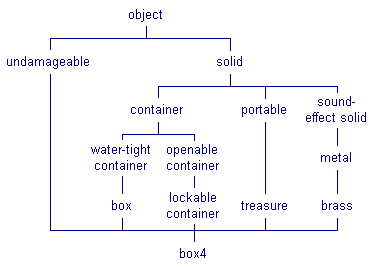
- 1. noun A collection of objects sharing similar permanent traits, in particular their common properties and uses. classes are arranged in an hierarchical fashion (a directed, acyclic graph, rather than a tree) and objects are therefore almost always members of more than one class. The main classes are objects, features, players, mobiles, containers, rooms and treasure. As an example of how classes are arranged, consider an object like the music box (box4); its place in MUD2's hierarchy can be represented something like this:
- Bleah!
- Note that in MUD1, objects are members of exactly one class, so for example brands are of class 'torch' but nothing else is, and they're not of class 'wood'; artificial classes have to be invented for some objects, eg. 'access' is the class for 'door'. Even worse bleah!
- 2. noun (Incorrectly), either muser or fighter. Sometimes, people brought up in a role-playing environment assume that these two distinctions are what D&D-style games call 'character classes', however they're not. Fighters are simply musers who can't use magic, and any advantages they have over musers can be counted on the fingers of one hand (and that's without the thumb!). The correct terminology is stream rather than class.
- 3. noun (Incorrectly) either PP or non-PP. Having found out that (2) is wrong, role-players will pick on the distinction between PPs and non-PPs as a place to hang their definition of class. Unfortunately, there is no agreed way to refer to these two groupings yet (although class in the D&D sense is definitely unacceptable), and it is therefore a little harder to prevail upon role-players that they are still wrong.
- clean out
- verb1 To remove all goodies from a room or area. "I cleaned out the Inn at the start of the reset, but I should have raced for a decent weapon instead".
- client
- noun A program which is run on a computer other than the host which facilitates connection to the game and manages its input/output so as to meet the player's requirements. This usually means a combination of pre-processor and post-processor facilities that augment those already performed by the FE. The particular program with which the client communicates is the server, which in MUD2's case means the FE, but which for most other client-using games means the interpreter itself.
- cliffy
- noun A rather old term which deserves to be brought back to the forefront of MUDspeke: a cliffy is a fact you tell a clueless newbie to stop them from pestering you for information (or, alternatively, as a joke). It can range from merely sending them on a wild goose chase ("Well where do you _think_ you'd find a gold club?") to the downright evil ("You use the <whatever they just asked about> to jump off the cliff" - this is the example which gave rise to the term). See scam, rumour, wind-up, fob.
- clique
- noun A group of similarly-minded wizzes, usually arranged against another group of similarly- minded (but oppositely-minded to the first group) wizzes. If the game gets too top heavy with active (2) wizzes, such fragmentation is bound to arise sooner or later, leading to game management problems. See brigade.
- clueless
- adjective Not having the mental facility to figure something out. This can be due to lack of experience (as in clueless newbie), lack of information ("Don't ask me, I'm clueless") or lack of mental processing power ("I've looked at the new mausoleum puzzle for over an hour, but I'm clueless").
- clutch
- noun The traditional collective noun for a group of zombies. Sometimes applied to other mobiles when several of the same type are encountered at once, eg. a clutch of dwarfs. By extension, jokingly used of large numbers of single-location guests, novices, mortals...
- CMP
- noun Abbreviation for 'Camelia Memorial Plaque', an object in the VAX incarnation of MUD2. A trophy awarded to mortal mortals in a yearly combat competition. There never was a persona called 'Camelia': this was a joke on the part of the competition's organiser. We split our sides laughing at that one... See GC.
- command
- 1. noun Meaningful text typed by a player to control a persona (usually their own, but not always...). Commands are written in a regular subset of English using words from the vocabulary and strings, the grammar being hard-wired into the parser. Commands are distinct from input, in that they've got past the parser successfully. The name comes from the observation that most of them are imperative sentences, although there is a smattering of interrogatives (eg. 'who', 'is', 'where'). Commands are passed from the FE to the binder part of the interpreter, which will dereference the nouns into objects (if possible) and create a set of single-object commands which can then be interpreted. See object, FE, vocabulary.
- 2. noun The main verb of a command (1). See object (5), instrument.
- comms
- noun Communications. The (usually phone-based) connection between the player's PC and the host. There are many comms problems that can intrude on a player's enjoyment of the game, most notably carrier loss and line-noise. The player runs comms software, which communicates through an RS232 port with a modem; the modem is attached to a telephone, and this is linked across BT's super-flaky network through specially-modified static-generating lines to a comatose exchange out of which a battery of further "best by June 23rd, 1943" lines wend their circuitous way to the modems attached to the host. These are arranged with a special trip switch such that if for any reason one of them becomes unusable, so do the rest. NB: modems attached to BT's network will not work if they have no large green circle on them. Or, for that matter, if they do. See also client, server, lagged off.
- CompuNet MUD
- noun The incarnation of MUD1 on the CompuNet network in the UK, the first commercial MUA in the world. Although an identical version 3A to Essex MUD, CompuNet MUD was characterised by bad game management which led to poor morale, plodders as wizzes, permanent hacking and slaying, and general all-round chaos. It ran from 1984 until 1987, when CompuNet abandoned the DEC-10 they were using.
- CompuServe MUD
- noun What non-BL players call BL when they can't remember its name.
- container
- noun The class of objects which can hold other objects inside them. Although, in theory, mobiles, players and rooms are all containers, the term is used in normal conversation to mean portable containers like bags, sacks, boxes and such. Officially, these are 'endocontainers', whereas mobiles etc. are 'exocontainers'.
- cramped
- adjective Having too many players and too few rooms. See sparse (1).
- creature
- noun The class consisting of all players and mobiles, ie. objects which are capable of issuing commands. Normally, creature is only used in describing the parameters of commands, eg. "You can follow creatures, but only help players". Most players will say both player and mobile if they mean them together, although true addicts might say "<cre>".
- creds
- noun Contraction of 'credits'. See creddies.
- creddies
- noun Credits, the unit of payment in MUD version 4B, and still used to refer to the time units charged in 4E. The term is gradually falling into disuse as it becomes superseded by the more street-wise creds. See Y.
- curse
- 1. verb1 The 'curse' command.
- 2. noun See POTM curse.
- cycles
- 1. noun The theory that an incarnation of MUD will swing pendulum-like from a period of pleasant, peaceful play into a state of vengeful, vindictive violence and back. The cycle from peace through war back to peace is reckoned to be around a year. "If you don't like it, quit and come back in six months".
- 2. noun Units of machine CPU power. "I wish people wouldn't keep setting up all these blanks, it takes up too many cycles".
